Memory 18 (31) January
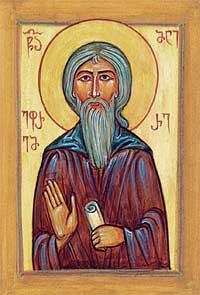
In 1027, when King Bagrat IV (1027–1072) ascended the Georgian throne, many noblemen of the Tao region in southern Georgia relocated to Greece. Among them was the honorable Vache, son of Karichi, whom scholars believe was Eprem’s father.
After receiving a Greek education in Constantinople, Eprem settled in the Black Mountains near Antioch and began his labors there.
His achievements in Georgian theological and philosophical writing are immeasurable. The number of his works is almost one hundred, and the subjects cover nearly every branch of theological inquiry. Eprem even developed his own theory of translation, which later formed the foundation for written composition in the Georgian language.
His theory consists of three essential points: 1. A composition must be translated from the original, that is, from the language in which it was first written. 2. The translation must carry the same literal meaning as the original, but accuracy in this regard must not violate the nature of the language into which the text is being translated.
3. A section of commentary that examines all relevant historical, grammatical, and literary issues should be included with the translated text.
Eprem translated five of the works of St. Dionysius the Areopagite, The Ascetic Rules of St. Basil the Great, the writings of St. Ephraim the Syrian, commentaries on the Epistles and Psalms, and many other important patristic writings.
Among Eprem the Lesser’s original works, his most significant is An Explanation of the Reasons for the Conversion of Georgia, a compilation of existing essays and his own commentaries on the nation’s conversion.
In the second half of the 11th century, the monks of Antioch and the Black Mountains began to deny the independence of the Georgian Church. Among other claims, they argued that none of the Apostles had preached the Christian Faith in Georgia. It became necessary to prove that the Georgian Church was indeed autocephalous, and members of the nation’s elite accordingly called upon Eprem to settle this issue.
Eprem studied many patristic writings in the original Greek, gathered the ancient sources, and succeeded in fully securing the independent existence of the Georgian Church.
St. Eprem wrote the following about the Apostles’ preaching: “Know that from the time the Apostles were preaching, according to the Prophet David: Their voice was heard through all the earth, and their words resounded in every village (c.f. Ps. 18:4). In Georgia, Andrew the First-called preached the Gospel in Avazgia (now Abkhazeti), and from there he journeyed to Ossetia (now Shida Kartli). Bartholomew also preached in Georgia, in the Kartli region.”
St. Eprem never left the Black Mountains. In 1091 he was enthroned as the abbot of Kastana Monastery[1].
Our holy father Eprem reposed in the Lord around the year 1101. He is included in a list of the departed compiled by the Council of Ruisi-Urbnisi in 1103, and the year of his death has been approximated from the information given in this source.
Eprem was canonized by the Orthodox Church of Georgia because of his God-pleasing life and the many commendable works he performed on behalf of the Church and his nation.
O bright star, all-honorable Father Eprem the Lesser, cease not thy prayers on behalf of those who celebrate thy holy memory!
[1] The precise location of Kastana is unknown, but according to modern archaeologists, it was probably in the Black Mountains. For a full discussion of the subject see: Wachtang Z. Djobadze, Materials for the study of Georgian monasteries in the Western environs of Antioch on the Orontes (Louvain: Corpus Scriptorum Christianorum Orientalium, 1976), pp. 101–3.