 |
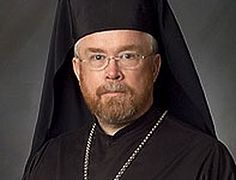
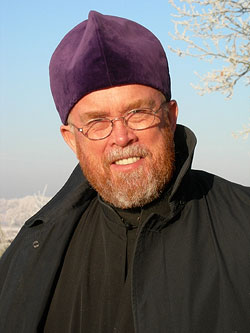
| Archimandrite Meletios (Webber) |
Fr. Meletios, you have another interesting side, in that you have written several books. Could you please name those books?
Of the two books that are published at the moment, the first is called Steps of Transformation, and that has a subtitle: An Orthodox Priest Explores the Twelve Steps of Alcoholics Anonymous. The second is called Bread and Water, Wine and Oil, and the subtitle is, An Orthodox Christian Experience of God.
The first book (people say that everyone has one book inside of them, and this is probably mine—the one I needed to write before I could write anything else) was really linking together my life as an Orthodox priest and my life as a psychotherapist who has been very much involved in recovery from addiction. It is something of a matter of opinion, but I have to say, hand on heart, that of all the methods that have ever been devised to help people recover from alcoholism, the work of Alcoholics Anonymous is preeminent.
There have been other attempts, ranging from the punitive, where people are actually punished if they ever drink again, to medical models, where people are made to feel very, very unwell, almost fatally unwell, if they attempt to drink again. But Alcoholics Anonymous comes through with a “program”—that is their word for it—which is spiritual in character; not medical, nor psychological. The notion that there is a spiritual way of healing fascinates me more than anything else.
I say, “spiritual,” and not “religious.” This is how Alcoholics Anonymous describes their work, because they are not affiliated with any religious body at all. People of any religious affiliation, or none, are welcome to join the ranks of AA if they choose to do so. So, there is talk of God in their meetings, there is talk of something that looks like confession, there is talk of something that looks like making amends to other people, and other points where you could say, yes, there is a clear parallel between the life of the Orthodox Church and Alcoholics Anonymous.
It was my great desire to point out these parallels; principally, so that Orthodox Christians throughout the world should, at the very least, look with some kindness on the work of Alcoholics Anonymous, and not dismiss such work as something unacceptable to them because it is not Orthodox in nature. I am an Orthodox Christian and I love the Orthodox Church, but there is a saying that goes, “if I am run over by a bus, don’t take me to the church; take me to the hospital.” I would say again from a place of pure conviction, that if someone is suffering from the condition of alcoholism then they need to go to AA. AA will then encourage them to go to church as well, but that’s the second step. Alcoholics Anonymous is, as far as I can see, the most powerful method of help to people who are stricken with what in most circles is accepted as a fatal disease.
Now, knowing that alcoholism tends to be widespread in Russia, do you believe that AA could benefit people there who have this problem, despite the fact that the Russian mentality is quite different from the American mentality?
Absolutely. AA is actually alive and well in Russia, although I haven’t got any personal contact there. But I know that in other countries, AA adapts to the needs of the host country in whatever it is that they are doing. So much so that the character of AA in the United States is a little bit different from what it is in Britain, and different again in the Netherlands. I think that without a doubt, there is a need to “Russify” the work of AA in order to make it appealing to Russians. I am not quite sure how to do this, although I have feelers out in different places, and I am beginning to make contact with people both in Russia and former satellite countries. It may be that the Russian solution in this area is not going to be the same, for example, as the Bulgarian solution, or the Greek solution. Every country has its own needs in this area.
One thing that people find difficult to understand—and indeed it is difficult to demonstrate—is that there is a big difference between people who drink too much and people who have alcoholism, although the two look very similar. Heavy drinkers might drink as much as alcoholics, and might kill themselves just as easily as alcoholics, and indeed destroy their family lives as much as alcoholics, but there is still an element of choice in their life which would allow them to stop drinking if they saw that it is imperative to do so. An alcoholic doesn’t have that choice any more. Now, how many people in Russia are alcoholics and how many are heavy drinkers, I couldn’t possibly say. I have no way of knowing.
Perhaps that would be harder to determine in a country where drinking is a big part of social life, as opposed to a society where drinking in general is frowned upon?
Right, I have a lot of experience—I am of Scottish descent, and the Scots have a big problem with alcohol as do the Irish, people in Scandinavian countries in general, and most Native Americans including the Aleuts and people associated with the deep north. Alcoholism, for example, in Greece seems to have a slightly different face from alcoholism in Scotland, for example, in that whereas Scottish people may drink with a view to getting drunk, in Greece there is still a big stigma attached to being drunk, although recently this has become less so. There is a lot of societal pressure against drinking to excess in Greece. So I think it is quite necessary to think in terms of “alcoholisms,” possibly of different ethnic natures, in trying to come to terms with helping people who are “stuck.”
But, having said that, from what little I do know about life in Russia, alcohol is being used to fill a need, which could so much better be filled in more positive ways. That is something I think no one could disagree with. I have spoken to lots of Russians on this theme, and I get from some of them fairly clear rationalizations as to why Russian people drink so much. I have been told about a particular devotion to a certain icon[1] that alcoholics are encouraged to follow. I have even heard about a church in St. Petersburg that has a special ministry to alcoholics, although I think that it is something of the “finger wagging” variety. I think they are mostly being told, “don’t do this, it is wrong, stop it.” But alcoholics don’t respond to those words at all, and that form of teaching doesn’t make any difference to them. They have been told for very many years to stop—by mothers, sisters, and daughters; unless they happen to be females, in which case, by husbands, etc.
The destruction by alcoholism of individual families from the inside out is universal wherever there is alcoholism, and I see that in Russia as much as anywhere else. So, it is a contributing factor to the difficulties of life in Russia, and it is an area where something can be done.
Do you suppose that there could be a different approach in rural areas of Russia, as opposed to that in the big cities? Drinking is widespread in the provinces now. Has AA tried to branch out to these far-flung areas?
New Alcoholic Anonymous groups are formed by people who live in a particular area. There is no leadership, and there is no spear-heading. So, the natural way for this to occur in, for example, a village where there is nothing else to do but get drunk (as I am told), would be for two or three people to decide that they do not want to do that any more, then get in contact with AA and some of its literature (which would by this time have to be in Russian, and in a form which they could assimilate). Then they would form the nucleus of a new group. There can be no question of missionaries going out—that doesn’t work. Alcoholics are extremely stubborn people. It is known what works in helping alcoholics, and what their tendencies are. That is what I would expect to happen.
In the large cities there are possibly already English-speaking meetings scattered around.
What’s happened, for example, here in the Netherlands, is that in some of the larger cities there are English-speaking meetings that are quite well attended. Then, gradually, Dutch people come to those meetings and have a natural desire to start a Dutch-language meeting of their own. That is the process that’s been happening here in the Netherlands during the last thirty or forty years, so by now it is quite well established.
Do you have any information from AA groups in Russia that show success in working with Russians, or rather, Russians working with themselves?
I don’t have access to any such information. The only information that AA can actually furnish is the number of official meetings (and a lot of meetings, particularly in Russia, may be unofficial), and a rough estimate as to how many people are attending these meetings, and that is all you ever hear. It is likely that there will be cores of sober people who make the meetings continue. This is true throughout the world. There will be others coming and going, for after all, alcoholism is a very insidious condition. It can catch up with one, and people who have been sober for twenty years can go back to a state of complete chaos simply by starting to drink again. So, there are difficulties in collecting information, and I must admit that I have none for Russia.
Especially since Alcoholics Anonymous places stress on anonymity, right? For the sake of delicacy, these people’s identities are not disclosed?
That is what anonymity means in the beginning, when people are just starting. They can feel safe that they are not going to be stigmatized in the local community for belonging. In fact anonymity has a much more profound spiritual significance, but they learn about that in due course. But in the beginning safety, of course, is a big issue for people.
Alcoholics Anonymous works because they are doing it themselves, right?
Precisely.
Because their own will is involved?
Not their own will. It is fundamental to the understanding of Alcoholics Anonymous and how things work, that the alcoholics hand their will back to the care of God. That is a crucial part of their recovery. I have to say, at its heart, alcoholism has very little to do with the drinking of alcohol. It is a condition which has been described variously. One way is to say that it is self-will run riot. Another way of looking at it (and this takes some research on the part of people who aren’t used to using these words), is that since alcoholism responds to spiritual recovery, then perhaps the essence of alcoholism lies in it being a spiritual malady.
So you think that this would have the potential for being a workable solution for Russians if only they knew about it?
Absolutely. And I see that if the experience in Russia is anything like what I am beginning to see in Romania and Bulgaria, the Church is very important in this development. Not by making it happen, because that can’t be, but certainly by approving that it be allowed to happen, and perhaps even by making the literature available, and providing rooms where people can have meetings.
Not only do the words need to be translated, but also the spirit (which is essentially Midwestern American), into something which is essentially Russian.