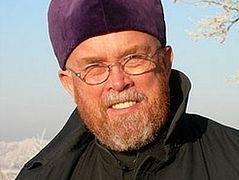
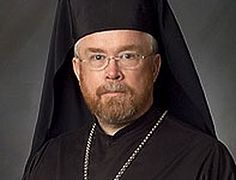
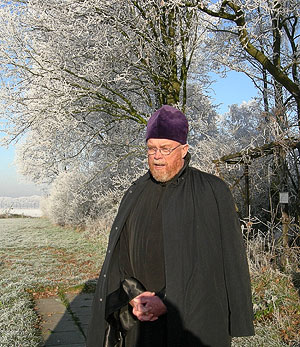
 Archimandrite Meletios (Webber) Archimandrite Meletios (Webber) |
| Archimandrite Meletios (Webber) |
What is your ministry like to the youth, and how do you bring young people into the Church? How do you feel about rock concerts, and Orthodox priests entering into such realms that are not Christian in nature in order to reach out to the youth?
The teenage years are years of rebellion. Teenagers have been rebelling in one way or another since the dawn of time. So, making teenagers conform to anything has been a heavy task for parents and educators for as long as men and women have been around.
Ultimately, teenagers on the whole—although of course there are exceptions—tend to be driven by peer pressure, and if peer pressure includes a spiritual dimension, then there will tend to be a spiritual dimension to their existence, although it may not be recognizable to anyone else. But if spirituality is entirely lacking—as it tends to be so in the Western world, even amongst fairly religious groups in the United States—you find that teenagers tend to spend time in rebellion. This means that ultimately you pray for the teenagers, and hope that they are going to come through those years without too many scars. The churches tend to pick them up once again when they become young parents. There is nothing wrong with that pattern, it just happens to be the one that seems to be in place.
Now, I know so little about rock music and things of that nature that anything I say is likely to be very doubtful, but let me put it in another context: I can’t say that I have ever met anybody who has been converted to Christianity by attending a symphony concert. Now, if that is true of symphony concerts, I think that that is also true of rock concerts. So rock music is an end in itself—I really can’t say if it is good or bad. But it is unlikely to provide much of a spiritual dimension for most people. It is a diversion, a distraction; it is away from the spiritual quest, rather than on the path. Therefore, I would say that it is somewhat irrelevant; I don’t think that having priests dress as rock stars is going to fill the churches.
What about priests attending rock concerts in order to reach out to the youth?
As I say, putting the same thing in the context of a symphony hall, having a priest sitting in the front row will not drive those people into the Church. The Church is good at being the Church. When the Church tries to be something else—and in the past it has tried to be all sorts of things, including government or administrator, sometimes because it had to, sometimes because it chose to—it is not at its best. The Church is essentially to do with living, and proclaiming the Gospel. The moment you start moving away from that occupation, then there is trouble.
Viewing the youth of Europe, do you see any hope? Does materialism totally prevail, or is there any yearning for traditional spirituality amongst the young people of Europe?
I think the Church has failed to make faith a living issue for a lot of people. I am not here talking necessarily about the Orthodox Church, although I have lived in Greece, and I have seen how the Church there has fallen short of bringing the Christian life to people living in that country. Here in Holland the churches are almost a dead issue, they are almost irrelevant to the life of the country. When youngsters come in contact with the Church—and now I am talking about the Orthodox Church—they tend to be quite taken aback by not only the spiritual strength which they encounter, but also the depth of experience which the Orthodox Church has. (I am talking about very small numbers of people.) That is because our favorite missionary method is simply to open a church door, and that is pretty much the extent of it. So if people choose to come inside, then we have a lot to share with them. But that is the limit of our activity in that direction.
Nevertheless, I also have a tremendous optimism. First of all, God is in charge, and no matter how badly we are doing, God is still God, and He is very good at being God. He has been doing it for a long time. In the end, God’s will will prevail, no matter how many obstacles we put in His path—or other people do.
This may be very wrong of me, but I see both in Europe and in the United States a quest on the part of young people towards what I suppose I could characterize as a quest for “goodness” as opposed to “rightness.” In the 1930’s and 40’s, certainly during the Second World War, Europe like most of the world was torn apart over questions of “rightness.” Goodness was not the issue at all—there was no goodness. Everything was bad. But the fascists thought they were right, and the communists thought they were right, and they tore each others’ throats out to settle it. What I do see amongst young people is a desire to pursue goodness for its own sake. This isn’t any big movement or anything of that nature.
I was a high school teacher for many years, so I have had much contact with teenagers. But simply from talking with teenagers, I would say that if there has been a trend at all, this is what it is.
Do you have any young people in Amsterdam who have just “wandered in?”
There are some. We also encourage teachers to bring classes. That is beginning to happen.
As a cultural experience?
Yes, because the Church has something very different to offer. The Dutch are living in a post-Calvinist society, where the Church has a rather dour, cold, forbidding aura about it. To come into the middle of a celebrating Orthodox community is actually quite an important event for them, even if it has no spiritual dimension at all.
The search for “goodness?”
Yes.
Is it difficult for the Russians and Eastern Europeans who immigrate here to adjust to Western European life? Do they go through a period of shock? What words of encouragement would you give to those who find themselves in Holland as their new home? How can they adapt themselves without losing what is best about their own culture and personalities?
I am never quiet clear as to why people come to Holland in the first place, unless they have a specific job offer in this country. Of all the countries in Europe, it is one of the most difficult for an Eastern European to apply to live in. Holland has its own language which is only shared with half of Belgium, and that’s that. So language tends to be something of an issue. Housing is expensive, and social services are no longer as generous as they have been in the past. Having said that, I can also say that many people, although not everybody, find Holland to be home quite quickly.
When I was little, I was intensely aware of the differences between Scotland and England. Most people, for instance, from North America, wouldn’t even be aware that there were such differences. Whenever you move from country to country, or indeed within a country, you are likely to come across some difficulties. Holland has a bureaucracy, which goes at it own pace. Holland has its own educational system, which is different from other people’s. Holland has its own medical services, which tend to have a different slant on things. You can go to a store in Amsterdam and buy marijuana, but you can’t go and buy penicillin. Things are just different.
Do you have any comment on the decision by the European Union to deny the Christian origin of European culture? And in contrast, on the recent attempt in the United States Congress to affirm and value this origin, and the essential role Christianity has played in the development of Western Civilization? What is the portent of this statement for the European Community?
I think that one of the most important factors in the modern world is that perhaps for the first time, the Church has become free to criticize any political leader. I think that the Gospel is, and always will be, at odds with most of the social systems we have developed, at least so far. And it is the Church’s task to call government to account whenever political governments are behaving in ways that are at odds with the Gospel. So, I think that it is interesting that America, in which the notion of the separation of Church and State really originated, or partially originated, is now wanting to affirm some Christian roots; whereas, in Europe, where Christianity is so much part of the life blood that it hardly needs to be talked about, such a statement is deemed to be unnecessary.
The high points in the life of the Church, spiritually speaking, have usually been the times when the Church has been heavily persecuted, and the low points, spiritually speaking, have been times when the Church has been allied with political power. Not always, but sometimes. So, I think it is largely irrelevant as to whether political powers seek to have their roots in Christianity or in any other religion, if they use that religion to justify whatever it is they are doing. So, the freer the Church is to comment on political life in the light of the Gospel, the better the situation is, everything else notwithstanding.
The experience of the Byzantine Empire, which remains somewhere in the consciousness of Christian society, has as its symbol the double-headed eagle signifying the harmonious functions of two heads in one body—the Church as the conscience of the Government, and the Government as the protector of the Church. Does this have any meaning for Europeans today?
Of course, the Byzantine ideal depends upon Christian emperors. That is a great deal more than emperors who happen to be Christian. In the good examples which Byzantium gives us, we see people who are of great spiritual depth, and under those circumstances it is possible for such a thing to exist. I don’t see that the way modern democracy works is likely to bring people who are more than nominally Christian into positions of leadership. People who are too demonstratively Christian are going to be wiped out in the primaries. That is the nature of the modern political machine. People with strong views about anything are likely to be wiped out. The people you are left with are those who are good at balancing, pleasing all sides. The Church is not like that. The Church should not be like that. The Church has a mission which hasn’t changed from the day that Jesus was physically amongst us on Earth. It is the call to repentance, the call to bring people back to God. Very few states can be seen to have been successful in doing that same thing.
You are speaking of states in the Western world, or states in general?
In general. I know that Byzantium is a beautiful idea for many, many people. Holy Russia is a beautiful idea for many other people. Yet both the Russian political system and the Byzantine political system fell short of the Gospel in many ways, at least during certain periods of history, and sometimes markedly so. Neither one was of the mold of modern democracy. Unless things change dramatically in the future, I don’t see that the sort of government that existed in Russia, and in Byzantium, is going to be a possibility at all. So I would see the future being where the Church and the State might be amicable, but the Church always needs to reserve the right to criticize. And many governments don’t particularly care for that particular part of the Church’s mission.
Do you think that this might be the underlying cause for this statement by the European Union?
To be honest, the people who seem to be making the rules in Europe at the moment baffle me entirely. I have no idea why they say anything. Or even who they are.
But you do not see this as setting the stage for more strictures on Church activities?
No, absolutely not.
They have fallen away from the Church, so they assume that all of Europe has fallen away from the Church?
Pretty much. In some ways, that is good for the Church. Wherever, for example, Catholicism has been hand in hand with a particular government in a particular country, you haven’t always seen Catholicism at its finest.
Being hand in hand with the government did not bring out its finest?
Precisely. On the contrary.
It brings out its worst?
Well, the Spanish Inquisition leaps to one’s mind, but there are other examples.
So, do you think that this decision could also have sprung from the Western European historical consciousness of abuses springing from a unity between Church and State?
The Christian background of Western Europe is so vast, and so omnipresent, that nobody could actually eradicate it. It is an historical fact, there to stay. That is the basis of what’s going on. Given the arrival of Islam into Spain and parts of Eastern Europe, it has always been one variety of Christianity or another which has dominated this area for 1200 years, in some places even longer.
And the new wave of Moslem immigration—are you feeling any pressure from this in Amsterdam?
I am almost certain that there is a solution waiting to be found to what appears to be a problem. Most Moslem people here in Holland are very happy to lead there own lives, doing what they usually do peacefully with what are usually post-Christian neighbors. There will always be layers of fanaticism in every society, but on the whole, the Moslem presence in Holland is something that most people can live with.
However, when people turn to religion to provide themselves with what one might want to call “ego identity,” simply because that identity is not present anywhere else, it transforms the religion into something which is rather distasteful, and also makes their own psychological make-up somewhat suspect. This isn’t the best way of finding an identity. That is the problem. If people only find some sort of living identity in their religious affiliation, then we’ve got a lot of work to do. Because in the end, religions aren’t made to coexist. Religions, by definition, tend to be at odds, and this has always been historically true for Christianity as well as Islam, there has always been a tendency for one to want to wipe out the other. They don’t live side by side naturally. Quite how we can get them to live side by side with some sort of friendliness, I am not quite sure, but that is the work that needs to be done.
Finally, do you have any words for the readers of Pravoslavie.ru.? Some wishes for the people of Russia, and her relationship to Europe?
I suppose my view is that the communists who took over Russian society at the time of the revolution were (and I think this is true), genuinely trying to improve society. But I also believe that the way they went about it, particularly becoming adversarial towards Orthodoxy, meant that their labors were, as it were, in vain. Russia is Orthodox to the marrow. I see it in the people who come to Church, who have no real academic or book knowledge of what Orthodoxy is all about, but who have a deep, deep reverence for Orthodoxy, and the life of Christ that Orthodoxy exhibits. Russia without Orthodoxy is, and has been, impoverished. It might be splendid in some ways, but there is something desperately lacking. And I am fairly certain that in God’s time the roots will be connected with the leaves. Then, what is in the depths of Russian history—what you might want to call the depths of the Russian soul (but perhaps that’s a little more dangerous)—will begin to manifest itself once again in positive ways, through growth, outreach, and commitment to the words of Jesus. That future is very bright indeed.